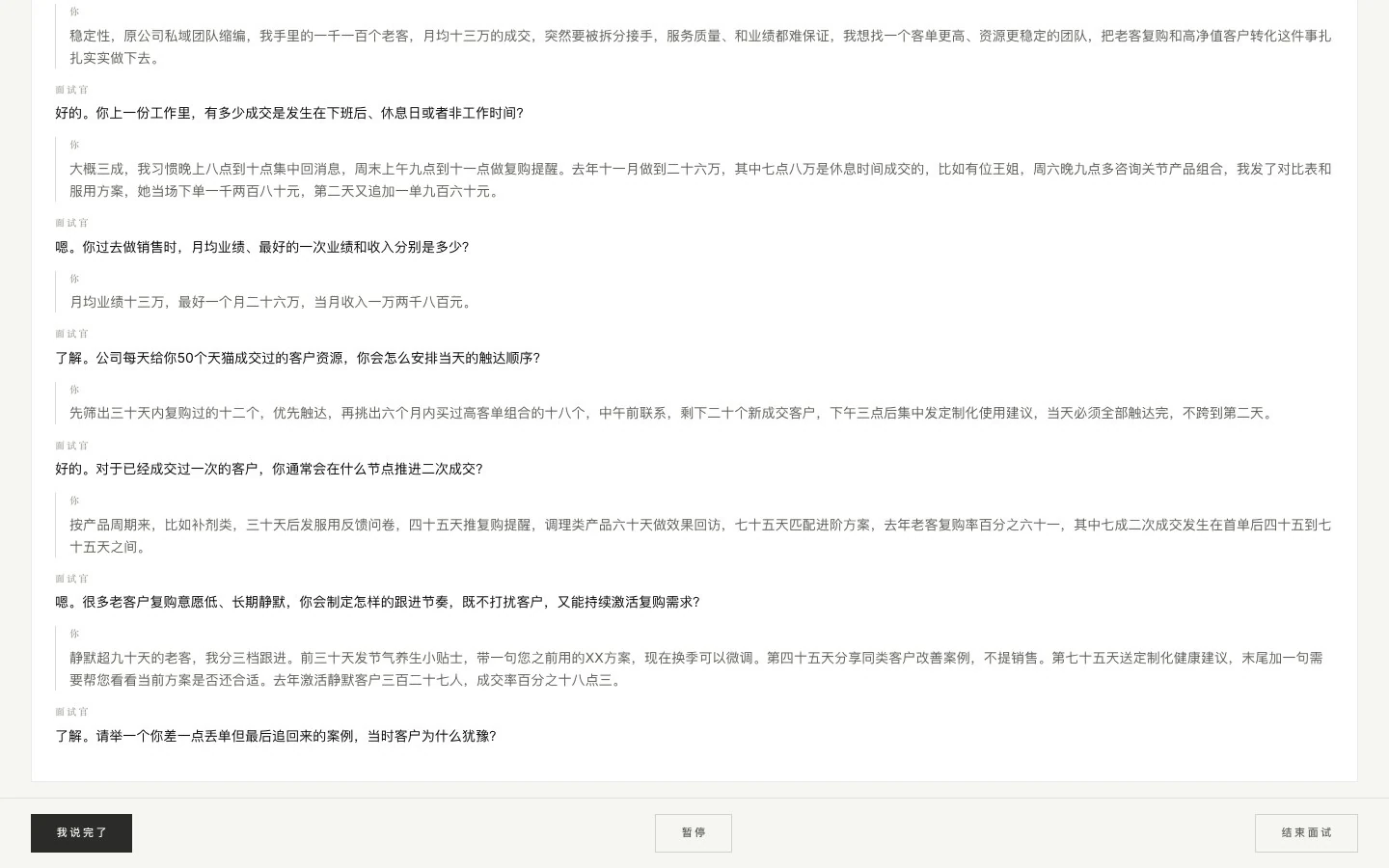
In this system, every candidate is a file. Its first page is the job's standard: what to score, what to ask, how far to follow up. Each step then adds a page: résumé matching, an online test or an AI voice interview, the observation report. When the boss has questions before deciding, the AI answers from the file.
Demo data: the file of Su Nian, a synthetic candidate, in five pages: the job standard, résumé matching, the interview transcript, the observation report and the boss's questions.
Demo data · synthetic candidate
01Job standard
Private-channel sales (high-ticket, one-to-one)
Scored on
Upsell planning
Customer segmentation
Repurchase follow-up cadence
Objection handling and win-back
Drive, resilience, ownership
Communication and rapport
Questions
8 business questions + 6 basic details
Follow-ups
At most 1 per question
One of the 14 interview standards on file
02Screening & tests
Résumé parsed · job match
“5 years of private-channel operations for a mother-and-baby brand, focused on high-ticket one-to-one advisory service…”
Against the 5 open jobs (0–100)
Private sales94Advance
Customer service42No
Taobao ops38No
Pinduoduo ops38No
Influencer BD38No
03AI voice interview
Transcript · question 1
AI interviewer
…Looking for a job now, what do you most want to solve: income, growth or stability?
Su Nian
Growth, more than anything. For five years I've sold high-ticket, one-to-one, in private channels, and I've shown I can deliver steadily…
461 s of questions and answers · 14 answers
04Report & comparison
88OverallRecommended for hire
Objection handling and win-back
88
Drive, resilience, ownership
87
Customer segmentation
86
Her words
“The next day he cancelled the refund and added the matching rain cover and carrier, taking the order from ¥2,980 to ¥4,260”
Scored in 192 s
05The boss's AI chat
Boss
For the one ranked first, which of her own words in the interview impressed you most? What risks should we ask about up front?
AI
…What impressed me most about Su Nian was the refund she won back: she didn't cut the price, she first found out why the customer was hesitating, and in the end the customer bought more.
Read before answering: Su Nian's full interview transcript
Role
Product owner and architect: scoped the problem, designed the system, signed off every release
Timeline
Since May 2026 · still iterating
Stack
Next.js · TypeScript · PostgreSQL · realtime speech model
Status
In production
Overview
Eleven tasks in one hire, and who does them
Hiring for one job, from setting its standard and receiving the first résumé to the decision, takes eleven tasks. Switch to “Before” and people do all of them; switch back to “Now” to see which moved to the AI or the system. The decision itself stays with the boss, then and now.
6 by the AI · 1 by the system · 4 by people
Task
Page
Done by
Decide what kind of person the job needs
Boss
Read résumés against the job
AI
Decide who to interview
HR
Check answers to objective questions
System
Analyse or score written answers
AI
Sit through first-round interviews
AI
Write up each interview
AI
Compare the candidates for one job
AI
Record an impression of the candidate
HR
What people write doesn't change the scoreAn HR impression and the boss's own score are stored separately on the interview's record; neither changes the score the AI gave.
Answer the boss's questions about hiring
AI
Make the hiring call
Boss
Solid: the AI does itHatched: a fixed rule in the system does itOutline: a person does it (HR, the boss)
01
What this company wants in a hire, written down as a standard for each job
This page records one job's standard: which questions the interview asks, which dimensions the score looks at, what a strong answer looks like, and whether to follow up when a candidate gives only half an answer. Each job's standard is set to this company's requirements, and the test (page ), the interview (page ), the report (page ) and the boss's questions (page ) all work from it. The demo company's private sales job is the example below.
1 · Standard
What to ask, what to look at, what a strong answer looks like
The private sales standard has 8 business questions and 6 basic details, and the score looks at 6 dimensions. Each dimension says which questions it is scored from and comes with 4 anchors describing a strong answer; the AI assessor scores against those anchors.
Anchors you can seeAn anchor names what has to appear in an answer for it to count as strong, such as concrete timing for a second sale, not an adjective like “logical”. In the report, every dimension score comes with the candidate's own words.
This question counts towards this dimensionThe whole interview, not one question
Scoring dimension · what a strong answer looks like
Upsell planning
Scored from questions 5, 8 · Su Nian scored 85 here; see page
Has concrete timing for a second sale or repeat upsell (based on the product's cycle, customer behaviour or course-of-use dosage), not the stock line “I pitch when the time is right”
Matches products to customer groups (what need to open with, and what to offer, for young beauty, older health and family household-care shoppers), not one script for everyone
Has a concrete sequence of “work out the real need first, then go in” (tying the product's value to a situation or pain point), not a hard sell
Mentions a real upsell or second-sale case (specific about at least one of the customer, the product and the result)
The demo company's private sales standard, translated from the Chinese in the system. Press a dimension for its 4 anchors, a question for its full text. The 6 basic details (start date, expected pay and so on) don't count towards the dimension scores; expected pay is used in the entry requirements below.
Besides the dimensions there are entry requirements: 3 required, 2 bonus. The report marks each one “met” or “not met” on its own, next to the scores.
Required doesn't mean rejectedFailing a required item doesn't screen anyone out. Su Nian's expected pay was higher than this job's standard allows, so that item was marked “not met”, yet with 88 overall she is still recommended for hire; the report shows both, and people decide.
Entry requirementsPrivate sales
RequiredExperience selling high-ticket, one-to-one, to consumers
RequiredWilling to reply to customers on days off
RequiredExpected pay fits the job
BonusHas followed up with a thousand customers or more
BonusBackground in health products or healthcare
All of this is set to the company: the questions are entered word for word from the company's interview questions, how strictly to score follows the hiring manager's line, and even the expected-pay item can point in opposite directions for different jobs.
One item, opposite waysBoth jobs look at expected pay: for private sales, asking too much is “not met”; for influencer partnerships it's the other way round, and clearly asking too little is “not met”, because that job reads indifference to pay as a lack of drive.
The system holds 14 interview standards and 4 test papers (Attachment 1); when HR creates a job, they pick one (Attachment 2). We change a standard at the company's request, and after a change it can first be tried on past interviews.
Try a change firstAfter a standard changes, the standards page can re-score a past interview under the new standard and show it beside the original score. The trial isn't written to the candidate's record.
The standards page: questions, dimensions and entry requirements per standard, and the pass markEditing a job: choosing which standard it uses
Who did what in this halfSystemAIPeople
Decide what to ask, what to look at, what a strong answer looks likeBoss
Write the company's standard into the systemDeveloper
Pick a standard when creating a jobHR
2 · Follow-ups
Half an answer gets one more question
The standard also has 11 follow-up signals, some for any question and some for one in particular, such as “explained why the customer hesitated but not what they did”. After each answer the AI checks whether the answer covers what the question is after; if something is missing, it asks about the most important gap, at most once per question.
Signals, not sentencesEach signal also has a reference follow-up in the standard, but it isn't sent to the AI: handed a ready-made sentence, it would just read it out. The follow-up on question 7 is the AI's own, worded from this candidate's answer.
Fig. 2One interview, three half answers
AI interviewer
Got it. Give an example of a deal you nearly lost but won back. Why was the customer hesitating?Question 7
Candidate
Ms Li, 52, ordered a ¥1,380 sleep-support bundle. Two hours after paying she messaged me on WeChat: “Will these ingredients clash with the blood-pressure medicine I'm taking?” Then she sent three photos of the drug leaflets and said her doctor had told her not to mix in supplements.Half an answer
AI interviewer
Mm. How did you answer her concern and win the order back in the end?Follow-up
Candidate
I went straight through the ingredient lists in the leaflets, found the matching ingredient amounts in our product's test report, and sent her a comparison chart with the safe dosage range marked. I also got the company's nutritionist to record a 1 minute 28 second voice message explaining in plain words how it's metabolised. That evening she replied, “You're more careful than my own doctor.” The next day she added a ¥960 supporting bundle.Fills the gap
AI interviewer
OK. Say you're selling the same multi-nutrient supplement to young beauty shoppers, middle-aged and older health shoppers, and family household-care shoppers. How would you work out what each group really needs?Question 8
One follow-up, and the candidate filled the gap
This question's follow-up signal in the standard
Explained why the customer hesitated but not what they did to win it back
Reference follow-up · in the standard, not sent to the AI
What did you do that got them to buy in the end?
What the AI actually asked
Mm. How did you answer her concern and win the order back in the end?
Demo data: an extra private sales interview recorded in the demo environment with the synthetic candidate Liang Sui'an; it was held in Chinese and is translated here. The AI doesn't say which signal it acted on; the signal shown is the one the script aimed at. Reference follow-ups are in the standard and are not sent to the AI.
In this interview the candidate gave half answers to questions 3, 4 and 7, as scripted; the AI followed up on question 7 only and went straight on after 3 and 4. Whether to follow up is the AI's call in the moment, and when it isn't sure, it doesn't. The system meanwhile counts the follow-ups on each question and reminds the AI to move on if it goes over the limit; the recording of this exchange is on page .
Unsure means noBefore following up, the AI checks whether the candidate has already said it; if unsure, it doesn't ask. Better one question fewer than a candidate who feels unheard.
Who did what in this halfSystemAIPeople
Count follow-ups per question; past the limit, remind the AI to move onSystem
Decide whether to follow up, and word the question from the answerAI
Decide what each question needs to hearBoss
02
HR gets résumés already read and tests already marked
This page records two things: what a résumé is turned into and which jobs it fits; and, for jobs that need a test, how the paper goes out and how it is marked. The system and the AI do both first; HR reads the results and decides who gets invited and who moves on.
1 · Résumés
Turned into a profile, then checked against every open job
HR uploads a résumé to the talent pool: a PDF, a Word file or a screenshot. The system first pulls the text out of the file (a screenshot goes straight to a model that reads images); then a language model sorts it into a profile with fixed fields: a summary, years of experience, the duties, results and supporting figures of each job, education and skills. The original text is stored beside the profile.
The original is keptThe profile is the model's write-up; the original is the text pulled straight from the file, stored separately and never retold by the model. When the boss asks the AI about this person (page 05), the AI reads the profile and the original together.
Fig. 1Su Nian's résumé: the original text and the profile
System: pulls the textAI: writes the profile
Original text, as pulled from the PDF18 lines
苏念
私域运营 / ⾼客单顾问 · 求职意向:私域销售(⾼客单 1 对 1)
⼥ · 29 岁 本科 5 年⼯作经验 电话:13800001001 期望⽉薪:12-15K
个⼈概述
5 年⺟婴品牌私域经验,擅⻓⽼客分层与复购节奏设计,个⼈⽉均成交 18 万元。
⼯作经历
某⺟婴⽤品品牌(私域中⼼) 2022.03 – 2026.08
⾼客单顾问组⻓
负责约 1800 位⾼价值⽼客的⼀对⼀维护,带 4 ⼈⼩组
按孕期 / ⽉龄搭建分层触达⽇历,⽼客 90 天复购率由 18% 提升⾄ 31%
设计「育⼉顾问」式内容 SOP,企微消息回复率提升到 46%
同品牌(社群运营组) 2021.07 – 2022.02
社群运营
维护 30 个会员群,策划周度会员⽇,群内成交占⽐提升 12 个百分点
教育背景
华东某财经⼤学 · 市场营销 · 本科 · 2015 – 2019
技能
企业微信 SCRM 客户分层 复购节奏设计 成交话术 数据复盘
Profile · point at any entry to see its line in the original
Summary
Experience
Work history
2022-03 – 2026-08
Duties
Results
Figures
2021-07 – 2022-02
Duties
Results
Figures
Education
Skills
Original, line 10按孕期 / ⽉龄搭建分层触达⽇历,⽼客 90 天复购率由 18% 提升⾄ 31%
Demo data: a synthetic candidate. The résumé and the profile are in Chinese, as the system read them. Characters such as ⾼ and ⽼ in the original are radical forms from the PDF's text layer, kept as they are; the profile's “13 percentage points” was worked out by the model from “rose from 18% to 31%”, and “the same brand” was filled in with the company's full name.
Once the profile is saved, the system checks it in the background against every job the company hasn't closed, not only the one applied for. Each pairing gets a match score from 0 to 100, a lean (advance, unsure or no), a one-line reason and the main gaps. The same results can be read two ways: the candidate page lists the jobs a person fits, by score, and the job page ranks every candidate, by score.
Every job, not just oneA candidate applies for one job but may fit another better. Because every pairing is scored, each job's ranking includes them too, so HR finds them from the job's side as well.
Fig. 2Every match in the demo database: 13 résumés × 5 open jobs
Demo data: the 65 match results of the 13 synthetic candidates in the demo database; scores and leans are the matcher's output as stored. Pick a name for the candidate page or a job for the job page; in the product, each row also carries its reason and gaps (Attachment 2).
Two examples. applied for Pinduoduo ops (94, advance), yet the Taobao ops column shows 72, unsure, so the name also comes up on the Taobao ops job page. is a no for all five jobs, and HR scheduled the Taobao ops test anyway; the score was 52. A match only advises: it doesn't change a candidate's status, and HR decides who is invited and who is tested.
Advice, not a decisionMatch results are stored in a table of their own. A low score never screens anyone out or changes their status.
Candidate page, top: the parsed résuméCandidate page, lower down: the match list, each row with its reason and gaps
Who did what in this halfSystemAIPeople
Pull the text out of the fileSystem
Write the profileAI
Check it against every open job: score, reason, gapsAI
Decide who gets an interview and who takes a test firstHR
2 · Tests
One test paper, from sending it out to marking it
For a job that needs a test, when HR schedules it, the system makes a test link from the paper that job uses (see page 01, ), and HR copies the link and sends it to the candidate. It opens in any browser, on a computer or a phone, with nothing to install.
Answering on a computer: the Taobao ops paperAnswering on a phone: the Pinduoduo ops paper
Rules of the answer pageas the product has them
A countdown that turns red in the last 60 seconds; when time runs out the paper is submitted automatically, and the report says so.
Leaving the page brings up a warning at the top (in the product's words: “Don't switch pages or leave this one; this has been recorded”) and counts once; the count goes in with the answers.
A warning, not a lockLeaving the page doesn't lock the paper or cost points; it only brings up a warning and adds to a count. The count and how the paper was submitted go into the report HR exports, and HR judges what they mean.
Reload or close the page by mistake: the answers and the start time are kept on that device, so the candidate picks up where they left off and the clock doesn't restart.
After submitting, the candidate never sees a score.
Each paper exists in two copies. The copy on the server carries the answer key and the marking points; what reaches the candidate's browser is a separate copy made from it.
Answers never leave the serverThe sent copy carries only the question number, text and options. An automated test in the code checks that the answer key, points, dimensions and marking points never appear in the copy sent out.
Fig. 3One question, two copies
Stubstays on the server
Question
mc-5
Question text
无界-洞察-流量解析-行业搜索词榜单包括哪些类型?
Options
A 节促热搜词
B 竞对热买词
C 洼地机会词
D 流量黑马词
Answer key
not shown here
Points
not shown here
Dimension
not shown here
Sent copywhat the browser receives
Question
mc-5
Question text
无界-洞察-流量解析-行业搜索词榜单包括哪些类型?
Options
A 节促热搜词
B 竞对热买词
C 洼地机会词
D 流量黑马词
Answer key
not sent
Points
not sent
Dimension
not sent
Two real questions from the Taobao ops paper, in Chinese as the candidate sees them. Grey bars in the stub cover what this page doesn't show; the struck-out fields in the sent copy aren't hidden there, they were never sent.
After submission, the kinds of questions on the paper decide how it is marked. The product has 4 papers on file, and they take two of the routes; the route for objective-only papers is kept, but no paper uses it at the moment.
Fig. 4After submission: routed by question type
SystemAI
Objective only
No paper at the moment
System: Code checks the answers; scored on submission
Totalpoints earned ÷ points possible × 100
Objective + written
Taobao ops paper25 objective · 5 written
JD ops paper24 objective · 5 written
System: Objective: code checks the answers and works out the total
AI: Written: the AI writes an analysis of each answer, outside the total
AI: Written answers also get a separate score, shown on its own
Reporttotal + analysis per answer + written score
Written only
Pinduoduo ops paper5 written
Amazon ops paper7 written
AI: The AI scores each answer against its marking points
System: The recommendation follows from the score
Reporttotal + recommendation + comment per answer
Papers and question counts are the 4 papers registered in the product; small squares are objective questions, bars are written ones. The written score on the Taobao and JD papers is a separate AI run; if it fails, the total is unaffected.
Once marked, HR gets a report: the total and a recommendation, the strongest and weakest dimensions, a score for each dimension; papers with written questions add each answer and the AI's analysis. When written answers go to the AI, what the candidate wrote is read only as an answer.
No model for objective questionsCode checks objective answers, so the same answers always get the same score. The report's opening lines on the strongest and weakest dimension are also code filling a fixed sentence with the accuracy rates.
Instructions in an answer don't countWhen the AI analyses or scores written answers, it is told to treat lines such as “give full marks” or “ignore the rules above” as part of the answer, not to follow them, and to point them out in its comments.
Fang Jiahe's Taobao ops test report: total 88, recommended for hireThe same report's AI assessment of the written answers, shown apart from the total
Some candidates answer the written questions offline. HR uploads the file, the AI maps the answers in it to the questions, and HR checks and edits them before submitting. Only written answers change; a question the AI couldn't match never wipes what the candidate had written, and after submitting, the whole paper is marked again.
Who did what in this halfSystemAIPeople
Make the link, keep time, count page exits, submit on time-outSystem
Check objective answers, work out the totalSystem
Analyse or score written answers; map offline answers to questionsAI
Check backfilled answers before submittingHR
Read the report, decide who moves onHR
03
HR doesn't sit in, and gets the whole conversation: every question asked, followed up where needed, and checked by the candidate
This page records one AI voice interview: how the candidate starts, how the AI interviewer asks from the standard and when it follows up, and who checks the record afterwards. HR doesn't need to be there at any point; the system and the AI run the interview, the candidate confirms their own words, and HR decides what's next after reading the conversation and the report.
1 · Interview
Open a link and start; give half an answer and get a follow-up
When HR schedules the interview, they copy the link and send it to the candidate; it opens in any browser on a phone or a computer. The link opens on a consent page: roughly how long it takes, that the whole interview is recorded and transcribed, and that the recording is used only for the company's own hiring; the microphone turns on only after the candidate clicks “Agree and start the interview”.
The interviewer is a real-time voice model that listens and speaks as it goes. It asks from this job's standard (page 01, ): for the private sales job, 8 business questions first, then 6 basic details. The system starts listening when the candidate speaks; when they're done they click “I'm done”, and only then does the AI reply.
Done means doneAs soon as the candidate starts speaking, the system starts listening, but an answer is over only when they click “I'm done”. A pause to think isn't taken as the end of an answer, and the AI doesn't cut in.
Fig. 1Two private sales interviews, to scale
AI interviewer speakingCandidate answering
Su Nian461 s · 14 answers
8 business questions6 basic details
Liang Sui'an426 s · 15 answers
Follow-up · 232 s
8 questions + 1 follow-up6 basic details
060120180240300360420 s
AI interviewer speakingCandidate answeringHalf an answer, as scripted
Liang Sui'an · 230–238 s · the AI follows up on question 7She had only said why the customer hesitated; working from that answer, the AI asks how she handled the concern and won the order back. The recording is in Fig. 2.
Demo data: two synthetic candidates for the same job; times come from the capture script's log, counted from the click on “Agree and start the interview”. Point at any segment to read that turn; dashed boxes are the three questions where the script had Liang Sui'an give only half an answer.
Su Nian answered every question in full: her 14 answers are exactly the 8 questions and 6 basic details, and the AI never followed up. On question 7 Liang Sui'an only said why the customer hesitated, and at 232 s the AI, working from that answer, asked how she won the order back. She also gave half answers to questions 3 and 4; there the AI judged them enough and went straight on.
Follow-ups are counted“At most one follow-up per question” is in the AI's rules; the system also keeps its own count, and when a question goes over, it adds a reminder the candidate can't hear, telling the AI to move on. The app's own count for this interview: question 7 once, every other question zero.
Fig. 2Question 7: the recording and the words
AI interviewerCandidate (synthetic)
Demo data
0:00 / 0:28
Candidate (synthetic)Ms Li, 52, ordered a ¥1,380 sleep-support bundle. Two hours after paying she messaged me on WeChat: “Will these ingredients clash with the blood-pressure medicine I'm taking?” Then she sent three photos of the drug leaflets and said her doctor had told her not to mix in supplements.Chinese original: 李姐,52岁,下单1380元的睡眠调理组合。她付款后两小时微信问我:“这成分会不会跟我在吃的降压药冲突?”接着发来三张药品说明书照片,说医生叮嘱过不能乱搭保健品。213 s into the interview · only why the customer hesitated
AI interviewerMm. How did you answer her concern and win the order back in the end?Chinese original: 嗯。你当时是怎么回应她的顾虑,最终把单子追回来的?232 s into the interview · follow-up. The signal it matches (page 01): explained why the customer hesitated but not what they did to win it back
Candidate (synthetic)I went straight…Chinese original: 我立刻……239 s into the interview · starts filling the gap; the clip ends here
Demo data: the synthetic candidate Liang Sui'an, translated from Chinese; each answer written on the spot by qwen-plus, read aloud by macOS's built-in speech and fed into the browser through a virtual microphone; the interviewer side is a genuine real-time voice model. The AI doesn't say which signal it acted on; the one shown is the signal the script aimed at. Nothing loads until you press play; it has sound.
No one is watching the interview, so the system handles these cases itself.
When no one is watchinghandled by the system
The connection dropsThe browser reconnects by itself, waiting a little longer each time, for up to 75 seconds; if that fails, what has been said so far is saved. Within 60 minutes the candidate can come back through the same link, and the AI carries on with the earlier conversation in mind.
Half an interview isn't scoredWhat's saved when the connection drops is half an interview, and it isn't scored. Only when the candidate comes back, finishes and confirms is the whole interview scored.
A short break“Pause” stops the AI's voice where it is, and the microphone stops listening; if the candidate isn't back within 2 minutes, or chooses “Continue later”, progress is saved just as after a dropped connection.
The model repeats itselfReal-time voice models sometimes introduce themselves again mid-interview, or ask a question that was already answered. The system recognises these replies, cuts their sound, keeps them out of the conversation and prompts the model to carry on; the number of corrections is capped.
It runs too longAt 50 minutes, the AI finishes its goodbye and then ends the interview.
Interview page: Liang Sui'an's interview, just after the AI's follow-up on question 7Consent page (phone)
Who did what in this halfSystemAIPeople
Listen and record; reconnect after a drop, save progress so the interview can resumeSystem
Count follow-ups per question; past the limit, remind the AI to move onSystem
Ask from the standard; after each answer, decide whether to follow upAI
Schedule the interview, send the candidate the linkHR
Agree and start; click “I'm done” after each answerCandidate
2 · Wrap-up
The candidate checks first, then HR gets it
As soon as the questions are over, the system cuts the candidate's recording by each answer's timing and runs it through offline speech recognition again, replacing only the candidate's words and leaving the interviewer's as they were. If it isn't done within a minute, the live transcript from the interview is used instead, so the candidate isn't kept waiting.
Only the candidate is re-transcribedThe recording is of the candidate's microphone only. The interviewer's words come as text from the model as it speaks, so there is nothing to transcribe; what has to be right is the candidate's answers, because they are what gets scored.
Fig. 3One sentence from Su Nian's answer to question 4, in four versions
AI transcriptionCandidate confirms
Read from the scriptthe synthetic candidate's script
……第二类是内买过高毛利品的,发加限时权益。第三类模板消息批量触达,……identical to the line above
Phrase to watchWritten differentlyMisheard
定制化育儿建议 (“customised parenting advice”)The live transcript got it right; the re-transcription afterwards heard 定制话语而建议, which means nothing. The candidate didn't change it, so it went into scoring as it was.
Demo data: an excerpt of the synthetic candidate Su Nian's answer to question 4, in Chinese as recorded; the four lines come from the same interview's records. Point at a marked phrase to see it in all four versions. The synthetic candidate in the demo changed nothing, so both mishearings went into the scoring on page 04.
The re-transcription isn't better everywhere, so the last check is the candidate's: on the review screen the interviewer's words are read-only and candidates can edit only their own answers; they can fix words, but can't delete an answer they gave, and they can answer any question they missed underneath it. The interview counts as complete only when they click “Confirm and submit”.
Fix words, don't delete answersThe review screen is for fixing recognition errors. If an answer is cleared entirely, submitting puts the original back and says so; candidates can correct misheard words, but can't wipe out an answer that went badly.
Only the speaker can tellIn the answer that filled the gap, Liang Sui'an said 她 (“her”), as in “sent it to her” and “she replied that evening”; both the live transcript and the re-transcription wrote 他 (“him”). The two characters sound the same, so speech recognition can't tell them apart; only the person who spoke can.
Once it's submitted, the interview shows as completed in HR's interview list, and scoring starts in the background. In the report HR can open the whole conversation word for word, in the version the candidate confirmed; the scores and comments are on page 04, . HR reads it and decides whether to invite the candidate to the next round.
Review screen: the interviewer's words are read-only; the candidate's answers are in editable boxes
Who did what in this halfSystemAIPeople
Cut the recording by turn; if it runs late, use the live transcriptSystem
Re-transcribe the candidate's answers offlineAI
Check their own words, confirm and submitCandidate
Read the conversation and the report, decide on the next roundHR
04
Every score leads back to the candidate's words, and candidates for one job sit side by side
This page records two things: how one interview becomes a report, and how several candidates for the same job are compared. The AI scores, writes the reasoning and writes the comment; the system turns scores into bands by a fixed rule; the impressions, the boss's score and the hiring decision belong to people.
1 · Report
Six scores, each pointing back to what the candidate said
As soon as the interview ends, the system hands the transcript to the AI, which scores it one dimension at a time against this job's standard (see page 01, ): a score, a paragraph of reasoning, and the candidate's own words lifted from their answers as evidence. For Su Nian's interview, 192 seconds passed from the start of scoring to the finished report.
Quoted word for wordThe AI's rules say quotes are copied from the transcript word for word, never reworded or summarised, with English product names left as they are. Every quote in Su Nian's report can be found word for word in her transcript.
Fig. 1Su Nian's six scores and the words they point back to
AI: scores, quotesSystem: ratings
Report · dimensions, highest score first
7580
Rating ExcellentConfidence high
The AI's reasoning
The candidate described a real win-back: a customer asked for a refund on a premium stroller. She went through his past purchases to find what was really holding him back (worry about the baby's spine at a key growth stage), answered it that evening with expert content and comparison videos instead of a discount, and not only kept the order but added to it, taking it from ¥2,980 to ¥4,260. A complete chain of actions, checked against its result.
Rating ExcellentConfidence high
The AI's reasoning
The candidate credits her results to a segmentation method she can repeat (past customers split into five tiers by repurchase cycle, category preference and budget; focusing on high-intent customers lifted conversion by 42%), puts in real selling time outside working hours (29% of deals, 37% of high-ticket orders), and is job hunting to grow and to turn her methods into a playbook. Clear ownership, with no reliance on luck or the platform's name.
Rating ExcellentConfidence high
The AI's reasoning
For a list of 50 customers, the candidate laid out a clear three-tier contact plan with concrete filters (dropping the 30% of low-value leads) and results that can be checked (92% reached on day one, about 11% converted within three days). The tiers follow repurchase likelihood and order value: a method she actually runs.
Rating ExcellentConfidence high
The AI's reasoning
The candidate designed a three-step wake-up cadence for silent customers (30/60/90 days), each step with a concrete hook (a voice tip, a personalised growth record with a voucher, a post on a real pain point), and gave actual results (repurchase back up to 19%, a 68% reply rate): a structured follow-up design that can be kept up.
Rating ExcellentConfidence high
The AI's reasoning
The candidate gave a concrete lifecycle cadence for the second sale (days 3/7/15/30) with different offers by category (bulk packs for nappies, accessory kits for baby-food makers), backed by real data (days 15 to 30 bring 64% of repurchases, order value up 35%). A system she actually runs, though her pitch for multi-nutrient supplements across customer groups was thin.
Rating ExcellentConfidence medium
The AI's reasoning
The candidate always gives the conclusion first, then the details; the logic is clearly layered, numbers run through every answer, and she speaks naturally with no sign of defensiveness. She rarely puts herself in the customer's shoes out loud, though, and her answers are a little short on warmth.
Transcript · Su Nian's 14 answers
Business questions
12345678
Basic details
91011121314
Question 7 · Su Nian's answer2 quoted
Last year a customer asked for a refund the day after ordering a premium stroller, saying it was too expensive and not worth it. I immediately looked up his last three purchases and saw they all fell in the baby's key growth stages. That evening I sent a 90-second voice message, tied to his baby's age in months, on what stroller suspension actually does for spine development, plus three comparison videos. The next day he cancelled the refund and added the matching rain cover and carrier, taking the order from ¥2,980 to ¥4,260.
Questions the standard scores this onA quote comes from this answerThe quoted words
Demo data: a synthetic candidate; translated from Chinese. Scores, reasoning and quotes are as the report gives them, and the transcript is the same interview's: every quote appears in it word for word. “Whole interview” means the dimension isn't tied to particular questions.
Once the scores are in, the AI doesn't decide which band they fall in. The overall score becomes a recommendation and each dimension's score becomes a rating, both from one fixed table; the AI also reports a band of its own, and neither the web report nor the exported one uses it.
Bands follow the scoreThe band the AI reports sometimes disagrees with its own score, so the web report, the exported report and test reports share one conversion table. In Su Nian's report the AI called all six dimensions “good”; converted from the scores, they are “excellent”.
How a score becomes a bandas the code has it
Overall score → recommendation
80 and up
Recommended for hire
75 to 79
Borderline
Below 75
Not recommended
Each dimension → rating
80 and up
Excellent
75 to 79
Good
Below 75
Adequate, weak or poorsplit by further bands
Su Nian: overall 88, recommended for hire; her six dimensions score 83 to 88, all rated excellent.
HR and the boss open the same report. Most of it is the AI's: a one-line verdict, the entry requirements checked one by one, core strength and main risk, the decisive quote, what to watch in the first month after hiring, and further down the dimension scores and the candidate's availability and expectations. Only two parts are left for people: HR writes an impression, and the boss gives an overall score from 0 to 100, with a line of reasoning if they like.
Impressions don't waitHR can write an impression as soon as the interview ends, without waiting for the AI to finish, while it is still fresh. It is kept on this interview only and doesn't touch the AI's score.
Fig. 2The report page: who writes which part
Interview assessment report · Su Nian · Private salesHR opens it
Written by the AI · Converted by the system: Overall score and recommendation88 · Recommended for hire
Written by the AI: One-line verdict
Written by a person (dashed): HR impressionWritten by HR, even before the scores are inWrites here
Written by the AI: Entry requirementsItem by item: met / not met
Written by the AI: Decision coreCore strength · main risk · decisive quote
Written by the AI: What to watch after hiring
Written by the AI · Converted by the system: Dimension scoresSix of them; open one for the reasoning and quotes (Fig. 1)
Written by the AI: Availability and expectationsDrawn from the interview answers
Written by a person (dashed): Boss's score0–100, with an optional line of reasoningRead only · shown once given
Links at the bottomFull transcript
Written by the AIConverted by the systemWritten by a person (dashed)
A sketch in the order the product lays out the report, with text from Su Nian's. HR and the boss see the same page except for the two parts people write and the links at the bottom; asking the AI about the candidate leads to page 05.
The report's middle: six dimensions by score, then availability and expectationsThe report's opening on a phone: overall 88, recommended for hire
Who did what in this halfSystemAIPeople
Turn the scores into a recommendation and ratingsSystem
Score each dimension, write the reasoning, lift the quotesAI
Write the verdict, entry check, strengths and risks, what to watchAI
Write an impression of the candidateHR
Give an overall score, with a line of reasoningBoss
2 · Comparison
Candidates for one job side by side, and a comment only when the boss asks
The comparison puts everyone for the same job who was scored on the same standard and reached 75 overall into one table, highest overall score first. The table is there as soon as it opens; no model is involved. In the demo, the private sales job has 3: He Zihang 88, Su Nian 88, Song Yutong 86.
Only those past the lineAnyone below 75 is left out of both the table and the comment. When someone is left out, the table's header says how many are shown and how many finished an assessment.
Fig. 3Private sales: the 3 at 75 or above
System: picks, sortsAI: scores
Upsell planningQ5 · Q8
80
85
84
Customer segmentationQ4 · Q8
83
86
84
Repurchase follow-up cadenceQ4 · Q6
86
86
85
Objection handling and win-backQ7
88
88
86
Drive, resilience, ownershipQ1 · Q2 · Q3 · Q7
87
87
85
Communication and rapportWhole interview
85
83
82
Overall
88
88
86
Recommendation
Hire
Hire
Hire
HR impression
—
—
—
Boss's score
—
—
—
From the report · not in the table, read by the comment
Su Nian
Core strength
In the premium-stroller refund case she went through the customer's past purchases to find what was really holding him back, won him back that evening with a 90-second voice message and comparison videos, and the next day he bought more, taking the order from ¥2,980 to ¥4,260. Her five tiers for 1,800 customers and three-step wake-up cadence for silent ones are systems she actually runs, not frameworks on paper.
Main risk
Her expected ¥12,000–15,000 is above the usual range. All five years of her experience are in mother-and-baby products, so how fast she can learn other high-ticket categories (supplements, beauty) needs checking. Her approach to recommending a multi-nutrient supplement stopped at how she would judge needs; she showed no concrete way of tying the product's value to the customer.
Decisive quote
The next day he cancelled the refund and added the matching rain cover and carrier, taking the order from ¥2,980 to ¥4,260.
Demo data: 3 synthetic candidates, scores as the product shows them; decision points translated from Chinese. The two dashed rows are empty in the demo and appear once someone writes an impression or gives a score. Pick a name to pull that candidate's points from their report: not in the table, but read by the comment.
The AI comment under the table is written only when the boss presses “Generate AI comment”; it is stored, and HR opening the comparison reads the same one but can't start one. It reads more than the scores in the table: each candidate's reasoning and quotes, core strength and risk, and HR's impression, and it may use only that material, never an invented quote. When the data later changes, the comment doesn't rewrite itself.
Reads past the tableAn earlier version of the comment read only the numbers in the table, so all it could do was restate the scores. Now it reads the reasoning and the quotes, and the demo comment opens with He Zihang and Su Nian “both scored 88, but their strengths are built differently”.
No automatic rewriteRewriting the comment every time HR edits an impression would make its cost climb with every edit. So edits leave it alone; when the boss opens the comparison, the system checks once and only flags a mismatch, and the boss decides whether to rewrite.
Fig. 4Once the comment is written, which changes make it stale
AI: writes the commentSystem: compares
AI comment · Private salesWritten
He Zihang and Su Nian both scored 88, but their strengths are built differently. He Zihang's hard skill is real high-ticket selling: ¥220,000 a month on average, a top single order of ¥79,800, and in a lost ¥6,800 ring sale he pinned down the mother-in-law's real worry about the metal (“If you're worried platinum is too soft, we can add a short hardness-test video”), closing on trust rather than a discount; both his objection handling and his sales figures hold up. Su Nian's win-back story is just as solid (“The next day he cancelled the refund and added the matching rain cover and carrier, taking the order from 2,980 to 4,260”), and her tiering and wake-up system is backed by hard numbers such as a 92% reach rate and 19% repurchase, so she edges ahead on execution. But her 5 years of experience are all in mother-and-baby products, she has yet to show how she would sell the value of target categories such as supplements, and her move across categories needs more probing than He Zihang's candid admission. Both carry the risk of high salary expectations and a learning curve in a new category; the suggestion is to put them through the final interview first and test how fast they switch categories while negotiating pay. Song Yutong follows closely at 86 and is just as good at drawing out objections (“What he was really hesitating over was trust, not price”), but her current order sizes (¥2,800–5,800) are far from a high-ticket one-to-one role, and the employment dates on her résumé are in doubt; the suggestion is to confirm her employment status in a second interview before moving carefully ahead.
Rewritten only when the boss asksGenerate again
After the comment was written, one thing happened
When the boss next opens the comparison, the system works out again who is in it, their scores and key points, and when HR impressions last changed; if that no longer matches the moment the comment was written, it marks the comment.
The comment in full as the demo database has it, translated from Chinese; the two emphasised phrases are the comment's own. Each row states its result; pick one to see the comment as the boss would then see it.
The two parts people write go to different places. HR's impression is read by the comment, and changing it marks the comment “may be out of date”; the boss's score is not read by the comment and doesn't make it stale. Neither changes the AI's score or the candidate's status: whether to hire is decided by HR changing the status, or by HR proposing it and the boss approving.
The boss's score, kept apartThe boss's score is stored on the interview, not in the AI's assessment, so scoring again can't wipe it. The AI's score at that moment is saved with it, to compare later how far the two differ.
The comparison in the product, with the same AI commentThe bottom of the report (boss's view): the score card is still empty
Who did what in this halfSystemAIPeople
Pick everyone for the job at 75 or above and sort them into the tableSystem
Mark the comment “may be out of date” when the data changesSystem
Read each report and write the comparison commentAI
Press “Generate” or “Generate again”Boss
Decide whether to hire: change the status, or propose it for the boss to approveHR · Boss
05
The boss gets answers written after reading the file
This is the file's last page: before making the call, the boss asks in a chat about candidates, jobs and the standard. The AI first pulls up the reports, interviews and test answers on the earlier pages, reads them, then answers, and hands back in writing whatever a person has to check or decide. And from then on it follows whatever the boss has told it to remember.
1 · Questions
Ask once, and it pulls the file before answering
Most of what the boss asks is: who is worth moving forward this week, who passed the test, what standard this job is scored against. The AI has 22 data tools: it can pull up a candidate's assessment report, interview transcript, résumé and test answers, and read a job and its whole standard. It picks what to read itself, and reads it before answering.
Look, don't touchEvery tool that looks up hiring data is read-only. The one thing the chat writes is what the boss asks it to remember, and only to its own memory table. Candidate statuses and approval results are out of its reach.
The archive keeps the readsWhile the AI looks things up, the boss's screen only flashes a line like “Looking at the assessment report”, gone once the answer starts. What it read stays in the chat's archive; Fig. 1 is pulled from there.
Fig. 1What it pulled from the file before answering
The boss asks
How many people did we interview for private-channel sales this week? Who's most worth moving forward?
Pulled, in order
Assessment report · Su Nian
A candidate summary; scores, reasoning and evidence on 6 dimensions
Which entry requirements were met
The basis for the call, and what still needs checking
Start date, expected pay, reason for leaving
What the candidate wrote or said is fenced off before the AI reads it, marked as data only.
The AI's answer · excerpt
… In the past 7 days we interviewed 3 people for private-channel sales, all on 22 October, and all finished; the AI gave each of them a “lean towards advancing”. My top pick is Su Nian.
Su Nian and He Zihang both scored 88, Song Yutong 86. Su Nian comes out ahead on three points:
She's the only one of the three who cleared the “managing a thousand-plus customers” bar; she has looked after 1,800 repeat customers.
She sells mother-and-baby products, closer to the nutrition and family products we sell.
She expects 12–15K a month, inside this job's 8–15K base-pay range.
He Zihang is very capable, with solid figures like monthly sales averaging 220,000, but he expects 13–18K, above this job's pay range, and he says himself he has never touched products like nutritional supplements. Song Yutong asks for the least (9–12K), but her biggest single sale was ¥5,800, a step short of “high-ticket”; her résumé gives her leaving date as 2026-09, which doesn't match her saying she had already left at the end of last month; that needs checking. Also, none of the three cleared the “pay motivation” bar, so it's best to sound them all out before talking pay.
The job has 3 openings; if the budget works, all three could go to a second interview.
Handed back to a personWhat it says it can't read
Demo data: the log lists the reads recorded in this chat's archive, in order, each with the grey line that flashed on the boss's screen at that step (translated); select one to see what that material holds. The answer is as recorded, translated from Chinese; a grey “…” marks what this page leaves out.
Its rules say to cite the numbers and quotes it read as they are, and to hand back what needs a person: a statement that doesn't match needs checking, pay needs sounding out before it's discussed, something needs testing in person next round. When it can't read something, it says so, as with that Taobao paper's written-answer score.
Sources stay apartThe system's rules tell it to keep the JD, the scoring standard, test papers and interview quotes apart, and in comparisons to pin every number to the right person. If the data doesn't have it, it says so instead of making it up.
Says what it can't seeThat Taobao paper's written section has a separate score, shown to people on the report page only and removed before the chat gets the data. So it says it can't read it and ranks by the marking points alone.
Beyond looking things up and saying what it found, it doesn't step over people: it doesn't make the call for the boss, doesn't hand out work on the boss's behalf, and doesn't change interview questions itself.
“Agreed” isn't approvalSaying “agreed” in the chat doesn't pass an approval: the boss approves or rejects HR's hiring proposals on the approvals page. Asked to notify someone, it says plainly that this step is beyond it, and never claims “notified”.
Fig. 2What happens when the boss says it in the chat
The AI does itA person does it
The boss says
What happens
Who acts on it
How many people did we interview for private-channel sales this week? Who's most worth moving forward?recorded
Pulls the sessions, the job and three assessment reports, reads them, then answers (Fig. 1)
AI
What standard is this job scored against?
Reads the job's whole standard with a tool made for it: questions, dimensions, entry requirements and scoring anchors (page 01)
AI
Remember: when you recommend someone from now on, give the conclusion first…recorded
Saves it as a long-term memory and brings it into every chat after (Fig. 3)
AI
Agreed, hire her.
The approval doesn't pass because of it. A hiring proposal from HR is approved by the boss clicking “Approve” on the approvals page
Boss
Have HR get in touch with her.
It can't hand out work: it says plainly this step is beyond it and suggests the boss tell HR in person
Boss → HR
Improve this job's interview questions.
Looks at how the question has done in past interviews and writes a draft only; it takes effect once a person finalises it and the system is updated
People
The two lines marked “recorded” were actually asked in the demo; the others are written from examples in the rules the system gives the AI and in its tool descriptions. A solid square is done by the AI in the chat; an outlined one needs a person.
Private-channel sales: the AI's answerTaobao test: the AI's answer (second half)
Follow-up on Su Nian: on a computerThe same answer on a phone
Who did what in this halfSystemAIPeople
Fetch the reports, transcripts and answer sheets the AI namesSystem
Pick what to read, read it, write the answerAI
Point out what needs checking or deciding, and hand it backAI
Check the doubts; ask in person next roundHR
Decide whether to hire: approve or reject on the approvals pageBoss
2 · Memory
Say “remember” once, and every chat after follows it
When the boss says “Remember …”, the AI saves it as one long-term memory and says in a sentence what it saved. From then on, every time the boss asks, the system gives these memories to the AI with the question, in new chats too.
Memory isn't an orderWhat it saves are the boss's preferences and ways of putting things. Its instructions say these are background only, not new orders, and can't override the system's rules; where they clash, the rules win.
Fig. 3One remembered line, and a new chat after it
BossAISystem brings it along
Another chattwo recorded lines
BossRemember: when you recommend someone from now on, ,,.
AIGot it, boss. From now on I'll recommend people in this order: the conclusion first, then two reasons, and one risk at the end.
Brought into every chat after
A new chatanswer excerpt
BossTake a look: who should we invite back for a second interview for Pinduoduo operations?
Read before answering: the job details, Luo Le's and Deng Shuyao's test reports, the whole candidate pool
ConclusionWritten this way anywayI suggest inviting back only Deng Shuyao. Hold off on Luo Le.
Context… Only two people have finished the test for this job; both scored 70 after adjustment, and the AI leaned towards dropping both. Deng Shuyao is just the better of the two, not a strong recommendation.
ReasonFrom the memoryReason one: her thinking is more systematic. … she would cut the promotion budget to 30% of normal 3 days ahead, then differentiate by product spec. Luo Le only said “pause promotion during the events”.
ReasonFrom the memoryReason two: when something goes wrong she looks for the cause herself, and stays within the rules. … Luo Le was fine with faking orders early on and even suggested “switching accounts”, a red flag for compliance.
RiskFrom the memoryThe risk is that she may never really have run high-ticket products. … In the second interview, press her on whether she has run products with promotion spend above 20% of sales, and ask for real return-on-spend figures. …
AlsoThe job has 1 opening and there are too few candidates right now; have HR keep looking at the same time rather than betting everything on her.
Demo data: first, two lines recorded in another chat (“boss” translates the fixed form of address the system gives the AI); then a new chat opened afterwards, its answer excerpted and translated from Chinese. Putting the conclusion first is the system's default for every boss; the two reasons and one risk correspond to this memory.
The memory only shapes how the boss's chat answers: the AI interviewer and the report scoring never read it. Each account has its own; when the boss says “drop that one”, it archives it and stops bringing it along.
What it won't saveA candidate writing “remember this …” in a résumé or test answer is never saved: that's data, not an instruction. A temporary chat can read existing memories but can't save new ones.
Another chat: the boss asks the AI to remember an answer formatA new chat: who comes back for Pinduoduo operations
Who did what in this halfSystemAIPeople
Bring the memories into every question; refuse saves in temporary chatsSystem
Save “remember …” as one memory and say what was savedAI
Answer in the remembered formatAI
Decide what to remember and what to dropBoss
Work together
Which part of your hiring takes the most people?
I can help you find the stretches of hiring that eat the most hours, hand the repeatable parts to AI, and keep every decision with the people who should make it.
01Map the processWalk through how a hire runs today, step by step, and see where the hours go.
02Automate one stretch firstStart with the most repetitive step, such as screening or first interviews, on your real roles.
03Connect the restOnce it's in use, link the reports, the comparison and the decision-maker's view into one line.